

Table of Contents
- Understanding Bulk Flag Orders for Municipalities
- Volume Pricing and Bulk Discount Tiers
- Procurement Standards for Municipal Flags
- 2-Ply Polyester vs Nylon Flags for Outdoor Durability
- Commercial Flagpoles for Schools and Government Buildings
- Commercial Grade Flag Hardware Replacement and Maintenance
- Flag Etiquette and Compliance for Public Spaces
- How to Request a Quote for Large Orders
- Frequently Asked Questions
Last Updated: August 29, 2026
Understanding Bulk Flag Orders for Municipalities
Bulk flag orders for municipalities require a fundamentally different approach than buying a single flag for your home. When managing flags for multiple government buildings, schools, or public spaces across a jurisdiction, you're establishing a procurement system that accounts for durability standards, compliance requirements, volume pricing, and long-term maintenance schedules.
At US Patriot Colors, we've worked with municipal procurement officers and facilities managers to understand what matters in bulk flag purchasing. The core challenge isn't finding patriotic-looking flags, it's finding flags that stay vibrant through salt air, harsh UV exposure, and constant wind while fitting budget constraints and meeting federal or state procurement standards.
This guide covers everything a municipal buyer needs to know: volume pricing, materials that perform best in different climates, hardware solutions that minimize maintenance, and procurement compliance navigation.
Volume Pricing and Bulk Discount Tiers
Volume pricing in the flag industry typically works in tiers, though breakpoints vary by supplier and flag type.
Here's what you should expect when placing bulk flag orders for municipalities:
| Order Volume | Notes |
|---|---|
| 1-5 flags | Standard retail pricing |
| 6-15 flags | Entry-level bulk discount |
| 16-50 flags | Institutional pricing begins |
| 50-100+ flags | Government and municipal tier |
| 100+ custom flags | Requires formal quote |
Discounts increase substantially once you cross into institutional territory, typically around 15-20 flags. This is where municipal buyers see meaningful savings.
The discount structure varies dramatically between standard flags and custom orders. A bulk order for 30 standard American flags might qualify for a discount, but custom state flags or municipal seals are often negotiated per-order. This is where requesting a formal quote becomes essential.
US Patriot Colors structures pricing to reward commitment. When managing bulk flag orders for municipalities across multiple buildings or a multi-year replacement cycle, savings compound significantly.
Procurement Standards for Municipal Flags
Municipal flag procurement isn't just about picking the best option. Government agencies and schools operate under specific procurement rules that affect which suppliers you can buy from and how you must document purchases.
Many state and federal procurement rules include "Buy American" provisions requiring flags to be domestically manufactured. If your municipality receives any federal funding, even indirectly through grants, your procurement officer likely faces restrictions on imported goods.
Municipal procurement typically demands that suppliers maintain a CAGE number (Commercial and Government Entity identifier) or be registered with SAM.gov (System for Award Management). This registration allows government agencies to verify vendor legitimacy and ensure compliance with federal contracting rules.
For bulk flag orders for municipalities, documentation matters as much as the flags themselves. Your procurement officer will need to verify manufacturing origin, material specifications, compliance with relevant flag standards, pricing transparency, and lead times.
US Patriot Colors maintains CAGE registration specifically for government sales, which simplifies the procurement verification process.
2-Ply Polyester vs Nylon Flags for Outdoor Durability
The material choice for outdoor flags determines replacement frequency and directly impacts the total cost of bulk flag orders for municipalities over multiple years.
Nylon flags have historically been the standard for outdoor use. Nylon resists UV degradation, maintains color vibrancy, and handles moisture well. For most climates, nylon performs consistently.
However, nylon struggles in high-wind environments. In coastal areas with salt spray or locations with sustained winds above 30 mph, nylon flags fray at edges, develop stress tears, and deteriorate faster than expected.
2-ply polyester changes this equation. Constructed with two bonded layers, it creates a heavier, more durable fabric that outperforms standard polyester and competes with nylon in high-wind conditions. The trade-off is cost, 2-ply polyester flags typically run higher than standard nylon.
For bulk flag orders for municipalities, choose materials based on climate and wind exposure:
- Mild climates, moderate winds: Standard nylon offers good value
- Coastal areas, salt spray exposure: 2-ply polyester or heavy-duty nylon
- High-wind zones (30+ mph sustained): 2-ply polyester is worth the premium
- Extreme climates (coastal + high wind): 2-ply polyester with reinforced stitching
If a nylon flag lasts 2 years in your climate but a 2-ply polyester flag lasts 4 years, the higher upfront cost disappears when factoring in labor and installation time saved.
Commercial Flagpoles for Schools and Government Buildings
Schools, government buildings, and public institutions need flagpoles engineered for permanent outdoor display and minimal maintenance. Residential flagpoles fail quickly in institutional settings.
Institutional flagpoles handle continuous wind exposure, frequent flag changes, and the weight of commercial-grade flags. A residential pole rated for 20 mph winds will vibrate excessively and fatigue faster when subjected to daily institutional use.
Heavy duty flagpole systems for schools and government buildings typically feature thicker-wall aluminum or steel construction, reinforced base mounting, commercial-grade halyard systems with ball bearings, and hardware rated for continuous outdoor exposure.
Wall-mounted flagpoles are the standard for schools, hotels, and government buildings. They attach directly to exterior walls or roof structures, eliminating ground-level foundations and reducing installation complexity. A wall-mounted flagpole displaying the American flag alongside a state flag is the visual standard for institutional settings.
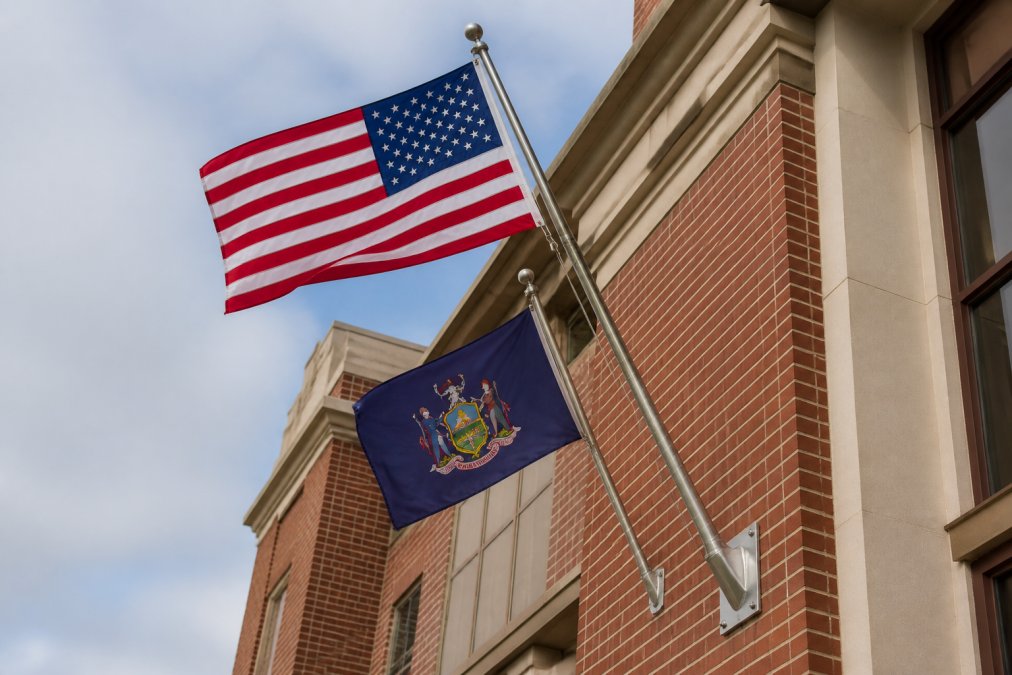
When planning bulk flag orders for municipalities across multiple buildings, standardizing on the same flagpole system simplifies maintenance and parts replacement. If five schools use the same wall-mounted model, you can stock replacement halyards, snap hooks, and finials for all of them.
US Patriot Colors offers Commercial Flagpoles and Wall Mount Flagpoles collections specifically engineered for institutional use, handling the weight of commercial-grade flags and frequent flag changes without vibration or noise issues.
Commercial Grade Flag Hardware Replacement and Maintenance
Flag hardware, halyards, snap hooks, brass grommets, and finials, wears out faster than flags themselves. This surprises most procurement officers planning bulk flag orders for municipalities.
In a school or government building flagpole system, the halyard experiences thousands of cycles per year. Each raise, lower, or adjustment causes the halyard to rub against pulleys. In high-wind conditions, the flag whips against the halyard, accelerating wear. A halyard typically needs replacement periodically.
Snap hooks crack, lose tension, and fail to grip flag grommets securely. Brass grommets can tear or deform, especially on flags raised and lowered frequently rather than left flying continuously.
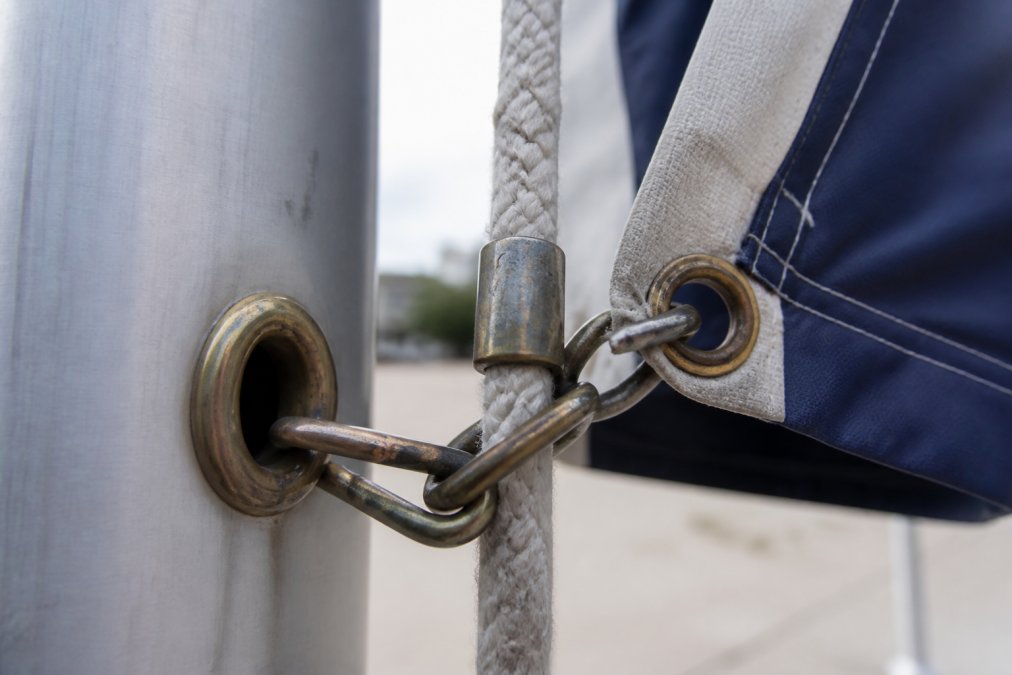
For bulk flag orders for municipalities, budget for hardware replacement as carefully as for new flags. A typical municipal flagpole system needs halyard replacement periodically, snap hook replacement periodically, grommet replacement periodically, and finial replacement periodically.
Commercial-grade hardware is engineered to withstand this cycle. Commercial snap hooks use stainless steel or galvanized finishes that resist salt air and UV degradation. Residential hardware corrodes faster and fails sooner.
When placing bulk flag orders for municipalities, ask about replacement parts availability. Some suppliers stock common parts; others require special orders taking weeks. For institutional buyers managing multiple flagpoles, immediate access to accessories / replacement parts collections prevents flags from flying damaged or being taken down during repair waits.
US Patriot Colors maintains inventory of commercial-grade replacement parts, halyards, snap hooks, brass grommets, and finials, specifically to support municipal customers needing quick turnarounds on maintenance.
Flag Etiquette and Compliance for Public Spaces
Flag etiquette rules for public spaces are stricter than most realize, and they vary depending on whether the building is a federal facility or a state/municipal facility.
For schools and municipal government buildings (non-federal), when the American flag is flown with a state flag, the state flag should be slightly smaller and positioned below the American flag. This is the standard at most state capitol buildings, county courthouses, and public schools.

The common misconception is that federal law requires flags to be exactly equal in size. This strict equal-size rule applies only to federal facilities and official federal ceremonies. State facilities and municipalities have more flexibility. A state flag that's 10-15% smaller than the American flag, positioned below it, meets proper flag etiquette for institutional settings.
For bulk flag orders for municipalities, this distinction matters because it affects which flag sizes you need to stock. If outfitting a school with both an American flag and a state flag, you might order a 4x6 American flag and a 3x5 state flag (slightly smaller, positioned lower). This is proper etiquette and looks visually balanced.
When flags fly continuously in public spaces, they should be illuminated at night or taken down at sunset. Many municipalities leave flags flying 24/7 with nighttime lighting, which is acceptable and increasingly common for government buildings.
How to Request a Quote for Large Orders
Requesting a quote for bulk flag orders for municipalities requires more detail than ordering a single flag online. Suppliers need to understand your specifications, timeline, and volume to provide accurate pricing.
Include these details in your quote request:
Flag specifications: Quantity and size of each flag type, material preference (nylon, polyester, 2-ply polyester), header style, any custom printing or embroidery, and desired delivery timeline.
Installation and hardware: Flagpole type and mounting location, halyard and snap hook specifications, and any custom hardware or finial requirements.
Procurement requirements: Whether made-in-USA certification is required, if CAGE registration or SAM.gov verification is needed, tax-exempt status, and required documentation or certifications.
Volume and pricing: Total order value and budget if applicable, whether this is a one-time order or part of a multi-year replacement cycle, and interest in volume discounts for future orders.
When you submit a quote request, suppliers can provide tiered pricing based on exact specifications rather than generic online pricing. This is where bulk flag orders for municipalities often see the most significant savings.
US Patriot Colors accepts quote requests for bulk municipal orders and can provide custom pricing based on your specific needs. We are excellent at custom flags and offer rush services. Include as much detail as possible in your request for the most accurate quote.
Bulk flag orders for municipalities require planning beyond picking flags. You're managing durability, compliance, maintenance cycles, and procurement standards. The flags that perform best in your climate, the hardware that minimizes maintenance, and the supplier that understands government procurement rules all factor into your order's true cost.
US Patriot Colors specializes in bulk flag orders for municipalities with made-in-USA flags, commercial-grade flagpole systems, and the procurement expertise to simplify government purchasing. Get a custom quote for your municipal flag needs and discover how volume pricing and durable materials reduce your long-term costs.
Frequently Asked Questions
What volume discounts are available for bulk flag orders for municipalities?
Volume pricing scales with order quantity. Most suppliers offer tiered discounts starting at certain unit thresholds. Exact pricing depends on flag material (nylon vs. polyester), size, and customization. Contact your supplier directly with your specific order quantity and specifications to receive a formal quote with applicable price breaks and tax-exempt documentation if needed.
What are the procurement standards for municipal flags?
Municipal flag procurement typically requires compliance with local purchasing policies, bid processes, and often state procurement regulations. Government agencies must document made-in-USA certification, material specifications, and durability standards. Many municipalities require suppliers to hold a CAGE number for government sales. Flags should meet commercial-grade standards for weather resistance, UV protection, and stitching quality. Verify your state or local procurement office requirements before issuing a purchase order.
How do I choose between nylon and 2-ply polyester for municipal flags?
Nylon offers superior UV protection and vibrant color retention, making it ideal for long-term outdoor displays. Standard polyester is more affordable but fades faster in direct sunlight. 2-ply polyester provides a high-wind option that resists tearing in severe weather while maintaining decent durability. For coastal or high-wind environments, 2-ply polyester or nylon are preferred. Consider your region's climate, flag replacement budget, and display duration when selecting material.
How often should municipal flags and flagpole hardware be replaced?
Flag lifespan depends on material and weather exposure. Nylon flags typically last 2-3 years in moderate conditions; polyester flags may need replacement every 1-2 years. Hardware components like halyards, snap hooks, and finials wear faster and should be inspected quarterly and replaced as needed. Coastal environments accelerate wear due to salt air and UV exposure. Budget for hardware replacement and plan flag replacement cycles based on your material choice and local conditions.