




Table of Contents
- Why Schools Outgrow Their Current Flag Supplier
- USA Flag Co Alternative for Schools: What to Compare Before You Switch
- 2-Ply Polyester vs Nylon Flags: Picking the Right Fabric for Your Flagpole
- Commercial Grade Flagpoles for Schools: What to Specify
- Required State Flags, Sizing, and Display Rules
- Flag Replacement Parts and Accessories Schools Should Stock
- Lifecycle Cost: Why Cheaper Flags Cost Schools More
- Conclusion
- Frequently Asked Questions
Last Updated: September 11, 2026
Why Schools Outgrow Their Current Flag Supplier
Schools rarely switch flag suppliers because of one bad flag. They switch because the math stops working. A flag that fades in a single semester, a halyard that frays twice a year, a pole that starts leaning after a decade of wind: those costs compound quietly until a facilities director adds up the replacement orders and realizes the cheap option was never cheap.
This guide from US Patriot Colors is written for the people who actually sign those purchase orders. If you are searching for a USA Flag Co alternative for schools, the real question is not which website has the lowest list price. It is which supplier can document domestic production, survive an audit, and keep a flag flying over a campus for years instead of months.
Three things separate a school-grade flag program from a consumer purchase:
- Documentation. Public schools answer to procurement rules. You need a supplier who can put origin claims in writing.
- Durability per dollar. A flag replaced every semester costs more than one that lasts three years, even at double the price.
- Service after the sale. Replacement halyards, snap hooks, and finials matter more than the initial flag order.
Keep reading, and we will walk through the criteria that decide a school flag contract, the fabric question that trips up most buyers, and the lifecycle math that makes the case for switching.
USA Flag Co Alternative for Schools: What to Compare Before You Switch
Comparing a USA Flag Co alternative starts with five criteria, not five prices. Price is the easiest number to find and the least useful one on its own. What decides a school contract is whether the supplier can prove domestic origin, deliver institutional sizes, and support the display for its full service life.
Five Criteria That Decide a School Flag Contract
- Documented domestic production. Ask for written confirmation of where the flag and pole are made. Procurement teams get audited on origin claims.
- Institutional sizing and construction. Schools need larger formats for gymnasiums and auditoriums, plus outdoor sizes rated for permanent display.
- Fabric matched to wind exposure. A coastal campus and a sheltered courtyard need different flags.
- Hardware quality. Brass grommets, reinforced fly ends, and proper halyard hardware determine how long a flag lasts.
- Replacement and parts support. Can the supplier ship a new halyard or finial without a full reorder?
|
Criteria |
What to Ask |
Why It Matters |
|---|---|---|
|
Origin documentation |
Written made-in-USA confirmation |
Survives procurement audits |
|
Institutional sizing |
Availability of large formats |
Gym, auditorium, and outdoor needs |
|
Fabric match |
Nylon, polyester, or 2-ply options |
Wind and sun exposure vary by site |
|
Hardware |
Brass grommets, reinforced fly |
Determines replacement cycle |
|
Parts support |
Halyard, snap hook, finial availability |
Avoids full reorders for wear items |
2-Ply Polyester vs Nylon Flags: Picking the Right Fabric for Your Flagpole
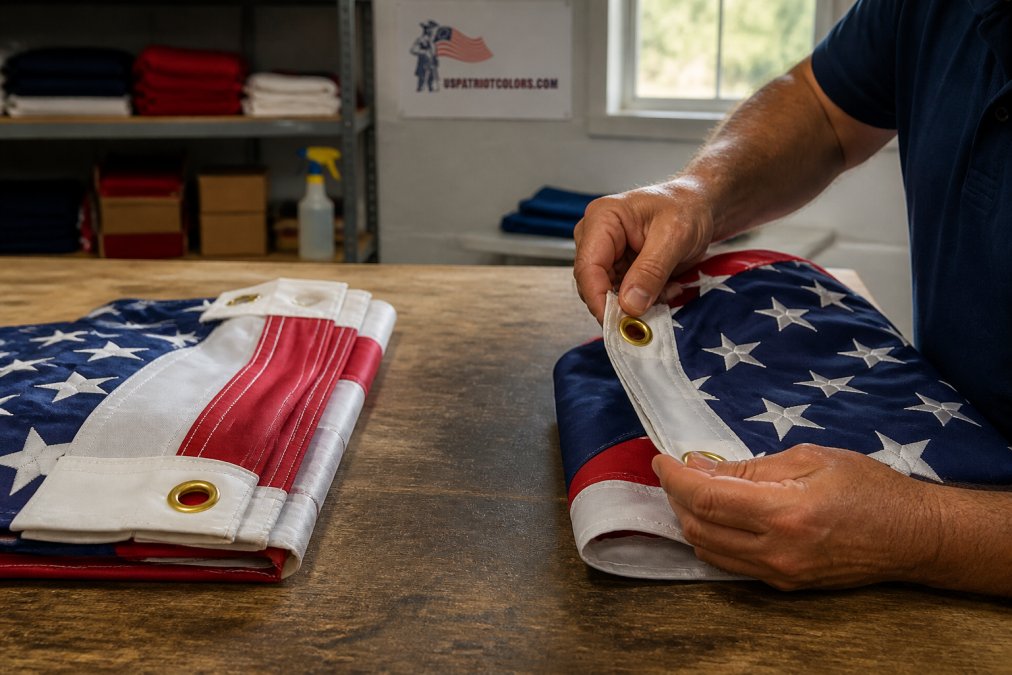
Nylon is the better choice for most school flagpoles because it is lightweight, dries quickly, and holds vivid color, while 2-ply polyester is the stronger pick for high-wind sites because its heavier weave resists fraying. Standard polyester sits between the two: durable and matte, but less bright than nylon.

Here is how the three compare for outdoor school display:
- Nylon: Lightweight, bright, fast-drying. Best for most permanent outdoor poles and moderate wind.
- 2-ply polyester: Heavier, matte finish, excellent high-wind performance. Best for exposed or coastal campuses.
- Standard polyester: Durable and economical, but less vivid and less forgiving in sustained wind. Not suitable for commercial use strictly residential or indoor displays and educational environments.
U.S. General Services Administration federal flag specifications sets the federal construction standards that many institutional buyers reference, including embroidered stars and sewn stripes rather than printed designs. For schools, that distinction matters: embroidered stars and sewn stripes hold up to UV exposure far better than printed alternatives, which is why institutional flags are built that way.
Commercial Grade Flagpoles for Schools: What to Specify
Commercial grade flagpoles for schools should be specified by wind rating, height, and foundation type, not by the lowest catalog price. A pole is a multi-decade asset, and the specification decisions you make at purchase determine whether it stands straight for twenty years or leans after five.
What to put in the specification:
- Wind rating. Confirm the pole's rated wind speed for your region and exposure category.
- Height and halyard type. Internal halyard systems reduce wear and deter tampering on open campuses.
- Foundation and base. The concrete foundation, not the pole, is where most installations fail.
- Mounting style. Wall mount flagpoles suit gymnasiums, auditoriums, and building facades, and they are what schools, hotels, and embassies typically use for large indoor displays.
For institutional settings, commercial flagpoles and wall mount flagpoles are the correct categories. Residential poles are not built for the wind loads or the duty cycle a school flag sees.
Required State Flags, Sizing, and Display Rules
In much of the country, a public school is required by law to fly its state flag. Public school systems are run by states and counties, and many states mandate that schools display the state flag, usually outdoors on school grounds and alongside the U.S. flag. Alabama law requires public schools and educational institutions to display both the U.S. flag and the Alabama state flag on flagpoles in front of the main building whenever school is in session.
At least 12 other states have comparable requirements:
- Alaska. The U.S. and Alaska flags must be displayed upon or near each principal school building during school hours.
- Arkansas. The Arkansas flag must be displayed on the schoolhouse or school grounds of every public school, on the same pole as the U.S. flag and immediately below it.
- Florida. The state flag must be displayed on the grounds of each elementary and secondary public school, and both flags must be displayed daily when weather permits.
- Iowa. Both the U.S. flag and the Iowa flag must be raised on all school days when weather is suitable.
- Kansas. An official state flag must be displayed on the school grounds each day of the school year, indoors if weather is inclement.
- Louisiana. The state flag must wave during regular school hours over public institutions of learning that fly the U.S. flag.
- Mississippi. The Mississippi and U.S. flags must be displayed in close proximity to the school building during daylight hours when school is in session.
- Nebraska. The U.S. and Nebraska flags must be prominently displayed on the school grounds of every public school each day school is in session.
- Oklahoma. The Oklahoma flag must be displayed during every school day from a flagstaff or pole, except in inclement weather.
- South Carolina. Schools must display both the U.S. and state flags under rules set by the State Board of Education, with the state flag flown consistent with U.S. flag protocol.
- Texas. Schools must fly the U.S. and Texas flags on all regular school days, and classroom display of both is required when the pledges are recited.
- Washington. The U.S. and state flags must be prominently installed, displayed, and maintained in schools.
A few states use weaker language. Georgia requires display on appropriate occasions as determined by local boards, and Ohio encourages the state flag at schools without mandating it. The details also differ: outdoor pole versus indoor display, weather exceptions, whether the flags share a pole, and whether classrooms are included. Check your current state education or general statutes for the exact wording, and when you budget a school flag display, put the state flag in the required column.
American flag etiquette for schools follows the same core rules as any display, with one point that trips up administrators: when a state flag flies alongside the federal flag, the state flag is slightly smaller and positioned below it. The strict equal-size guideline applies to federal facilities, not state facilities. The common belief that the two flags must be identical in size is wrong for a school.
Other display points worth confirming with staff:
- The American flag occupies the position of honor, to its own right.
- Raise the American flag first and lower it last when flags are flown together.
- Flags displayed flat against a wall should have the union to the observer's left.
For a large indoor display, a wall-mounted American flag is built for exactly this purpose: institutional scale, secure mounting, and a header system designed for gymnasium and auditorium walls. These are made to order, so plan around the production lead time.

Flag Replacement Parts and Accessories Schools Should Stock
Flag replacement parts fail long before the flag does, and that is the part most buyers miss. Halyards fray, snap hooks corrode, finials loosen, and flags themselves eventually fade. A school that stocks the wear items avoids emergency orders and keeps the pole in service. For a public school, stocking them also means running the purchase through the right procurement channel, which is where most guides go silent.
The Wear Items That Need Periodic Replacement
Every item below has a shorter service life than the pole it hangs on. Treat them as consumables with a replacement schedule, not as one-time purchases.
- Halyards and rope for both internal and external systems. Rope and cable both chafe at the pulley and at the cleat.
- Snap hooks and flag clips in the correct size for your halyard. Corrosion and bent gates are the usual failure points.
- Finials and ornament bases to replace damaged or missing tops. A loose finial is a wind-driven projectile risk on an open campus.
- Replacement flags in the sizes your campus actually flies, including the state flag that flies alongside the federal flag.
- Grommets and header hardware on flags that see permanent outdoor display.
A practical pattern is to inspect the halyard, snap hooks, and finial at the same time you inspect the flag. If the fly end is frayed or the color has faded, the flag is due for retirement, and the hardware is usually close behind.
Buying Wear Items Through a School Procurement Process
Public schools rarely buy the way a homeowner does. Two mechanics shape how a flag order actually gets placed.
Tax-exempt purchasing. Public school districts generally hold a state sales tax exemption, and many suppliers can accept a valid exemption certificate so tax is not applied to the order. Confirm the supplier's process before the purchase order is cut, because correcting tax after the invoice is far more work than setting it up correctly the first time.
Purchase orders and approved vendor status. Most districts require a purchase order rather than a card payment, and some require the supplier to be set up as an approved vendor before the first order. Ask early whether the supplier can accept a district purchase order, provide a W-9, and issue an itemized invoice that matches the PO line for line. A supplier set up for institutional buyers can usually do all three without escalation.
Cooperative and bid contracts. Larger districts sometimes buy through cooperative purchasing agreements or a formal bid. If your district uses one, confirm the supplier can sell through that vehicle before you build the specification around them.
Ask three questions before the first order: Can you accept our tax exemption certificate? Can you take a district purchase order? Can you provide a W-9 and an itemized invoice? A supplier who answers yes to all three is built for schools. One who hesitates is built for retail.
Lifecycle Cost: Why Cheaper Flags Cost Schools More
Cheaper flags cost schools more because the purchase price is only the first line item. The real cost includes replacement frequency, staff time for installation, and the administrative overhead of reordering. Most buying guides stop at the invoice. A cost-per-day model is what actually settles the argument in a budget meeting.
How to Build a Cost-Per-Day Comparison
The formula is simple: total cost of ownership divided by the number of days the flag stays serviceable. Four inputs drive it.
- Purchase price per flag. The invoice line, nothing more.
- Expected service life. How many months or years the flag stays presentable under your site's wind and sun exposure.
- Labor per replacement. Custodial time to lower the old flag, attach the new one, and dispose of the retired flag properly.
- Administrative overhead. Raising a purchase order, receiving, and processing an invoice. On a small order, this overhead can exceed the flag itself.
A flag that lasts three years at a higher upfront price almost always beats a flag replaced every semester, because the labor and paperwork repeat with every replacement while the purchase price does not.
|
Cost Factor |
Low-Cost Imported Flag |
Institutional Domestic Flag |
|---|---|---|
|
Purchase price |
Lower upfront |
Higher upfront |
|
Replacement cycle |
Months, not years |
Years with proper care |
|
Staff time |
Repeated install and takedown |
Minimal after setup |
|
Reorder overhead |
Frequent purchase orders |
Occasional |
|
Origin documentation |
Often unavailable |
Provided |
|
Cost per day of service |
Higher once labor and reorders are counted |
Lower across the full cycle |
Where the Hidden Costs Hide
The line items that never appear on a quote are the ones that break the budget:
- Emergency reorders. A flag that fails before a ceremony or an assembly forces a rush order, and rush service costs more than planned replacement.
- Wear items on their own cycle. Halyards, snap hooks, and finials fail on a different schedule than the flag. If you are not stocking them, every failure becomes a separate purchase order. Keep halyards, snap hooks, finials, and replacement flags on hand so a single order covers the whole pole.
- Pole damage from neglect. A frayed halyard that snaps in high wind can whip the pole and damage the finish. Maintaining the wear items protects the multi-decade asset underneath them.
- Retirement and disposal. A flag no longer fit for display has to be retired properly, which is staff time whether you fold it away or hand it to a scout troop for a ceremony.
Build the comparison as cost per day of service, not cost per flag. When you evaluate a USA Flag Co alternative for schools, the supplier who can document a longer replacement cycle and supply the wear items in the same order wins the math every time.
Conclusion
The challenge for most schools is not finding a flag. It is finding a supplier who can document domestic production, deliver institutional-grade construction, and support the display for its full service life. US Patriot Colors builds exclusively made-in-USA flags and flagpoles for government, municipal, and school buyers, with custom flags for schools that need their own colors or mascot alongside the Stars and Stripes, a CAGE number for government sales, and construction rated for demanding conditions. Stock your wear items from the replacement parts and accessories range, and specify wall mount flagpoles for gymnasiums and auditoriums. Get started with US Patriot Colors and equip your campus with a display built to last.
Frequently Asked Questions
Are schools required to display the American flag?
There is no federal law that requires every school to fly the flag daily, but many states have their own statutes or district policies that call for a flag display, particularly at the start of the school day. Most schools that do display it follow the U.S. Flag Code, which sets the rules for positioning, lighting, and respect. Check your state education code and district policy to confirm what applies to your buildings, then document the display schedule so staff turnover does not disrupt it.
How should state flags be displayed alongside the American flag at schools?
When a school flies its state flag with the American flag, the state flag is slightly smaller and positioned below the U.S. flag. The strict equal-size guidelines that apply at federal facilities do not apply to state facilities, so the common assumption that both flags must be identical in size is incorrect. Order matters too: the American flag occupies the position of honor, which is the flag's own right, and the state flag follows.
What is the difference between nylon and 2-ply polyester flags for outdoor use?
Nylon is lightweight, dries quickly, and catches a light breeze well, which suits most school flagpoles. Two-ply polyester is heavier, holds color longer in strong sun, and handles high-wind exposure better, so it is the better pick for exposed or coastal campuses. Both are made in the USA options here. If your pole sits on an open field with constant wind, 2-ply polyester usually lasts longer between replacements than standard nylon.
How often should school flags be replaced due to wear and tear?
Replacement intervals depend on sun exposure, wind, and how many hours the flag flies. Flags left up overnight in full sun and wind wear fastest, while flags taken down in bad weather last considerably longer. Inspect the fly end, grommets, and header each term. When you see fraying at the fly, stretched grommets, or noticeable fading, replace the flag. Keep a spare on hand so a torn flag never stays up.
Can public schools use tax-exempt procurement for flag purchases?
Public school districts typically hold tax-exempt status and can submit a valid exemption certificate when purchasing flags, poles, and accessories for school use. Many suppliers, including US Patriot Colors, accept purchase orders from schools and municipalities, which lets you buy through your normal procurement process instead of a personal card. Confirm your district's exemption documentation and vendor setup requirements before placing the first order so invoicing goes smoothly.


